Timshel
Timshel is the Hebrew word that forms the theological and philosophical core of John Steinbeck's East of Eden. It is the single verb around which the novel's deepest argument about human nature, moral choice, and the possibility of redemption revolves. The word appears in the King James Version of the Bible as "thou shalt" and in the American Standard Version as "do thou," but Lee, the Chinese-American servant who becomes the novel's moral and intellectual center, discovers through years of painstaking scholarship that the original Hebrew carries a radically different meaning: "thou mayest." This distinction, between a promise, a command, and a choice, is the difference between a world in which human beings are helpless before their fates and one in which they are the authors of their own destinies.
Discovery and Translation
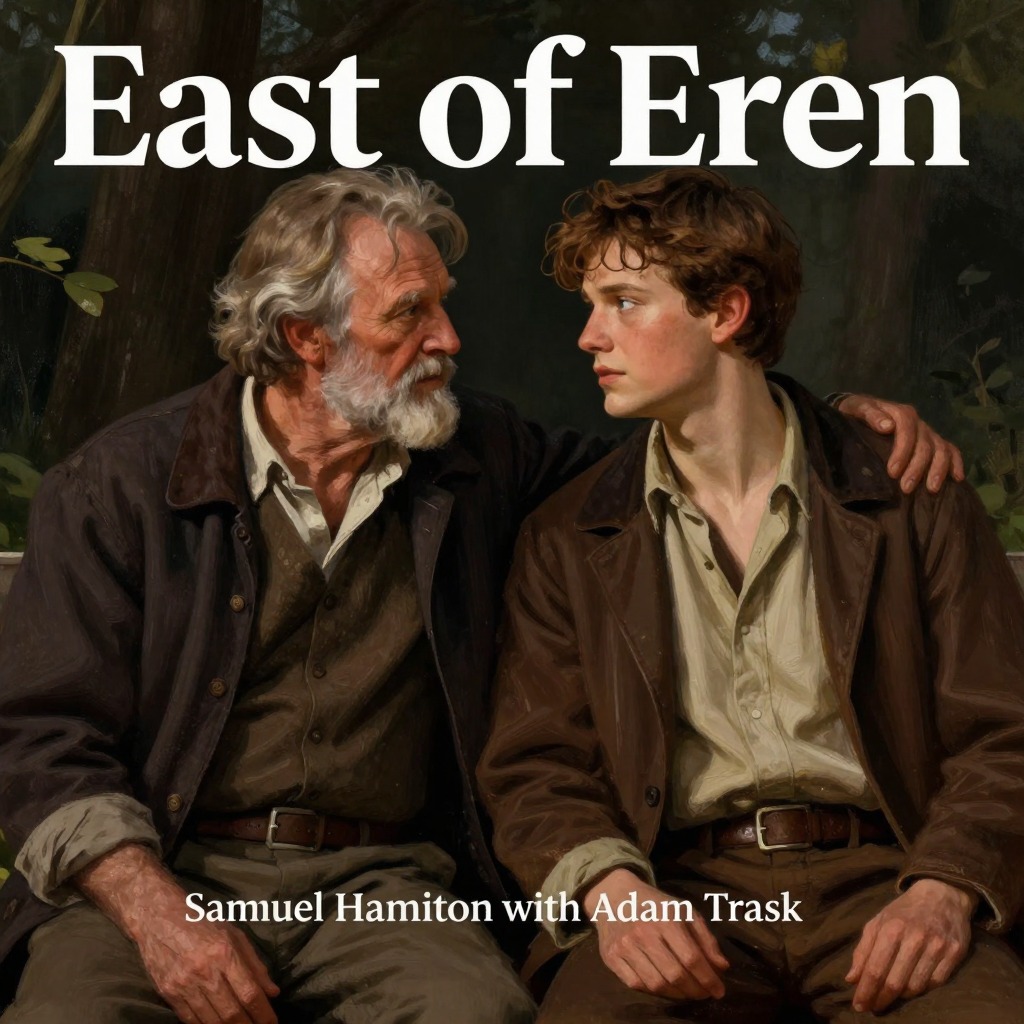
Lee's quest for the true meaning of the word began after the naming of the twins Caleb and Aaron, when Samuel Hamilton read the sixteen verses of Genesis 4 aloud under the oak trees at the Trask ranch. The story of Cain and Abel troubled Lee deeply, particularly the passage in which Jehovah tells Cain, "If thou doest well, shalt thou not be accepted? and if thou doest not well, sin lieth at the door. And unto thee shall be his desire, and thou shalt rule over him." The King James "thou shalt" struck Lee as a promise that Cain would conquer sin, while the American Standard "do thou" seemed an order. Neither satisfied him, and he began to suspect that the original Hebrew might hold a different truth. He took his question to the headquarters of the Lee family association in San Francisco, where four elderly Chinese scholars, the youngest over ninety, agreed to help him. They engaged a learned rabbi and began studying Hebrew from scratch, writing the characters with brushes in Chinese ink. After two years of study, they concluded that the original word was timshel, which means "thou mayest." The old gentlemen smiled and nodded, feeling the years were well spent, and immediately turned to studying Greek.
The Meaning of Choice
Lee explained the significance of the discovery to Adam and Samuel during the same conversation in which the twins were named. "The American Standard translation orders men to triumph over sin, and you can call sin ignorance," Lee said. "The King James translation makes a promise in 'Thou shalt,' meaning that men will surely triumph over sin. But the Hebrew word, the word timshel—'Thou mayest'—that gives a choice. That says the way is open. That throws it right back on a man." For Lee, this was the most important word in the world, because it affirms that human beings are not merely the products of their ancestry, their circumstances, or their inherited natures. "It is easy out of laziness, out of weakness, to throw oneself into the lap of deity, saying, 'I couldn't help it; the way was set,'" Lee said. "But think of the glory of the choice! That makes a man a man. A cat has no choice, a bee must make honey. There's no godliness there." The word timshel gives human beings stature with the gods, for in their weakness and their filth and their murder of their brother they still have the great choice: they can choose their course and fight it through and win.
The Word in Action
The concept of timshel reverberates through the novel's climactic scenes. When Samuel Hamilton, near the end of his life, tells Adam the truth about Cathy's whereabouts and profession, he does so knowing that the knowledge may kill Adam—but he also knows that without it, Adam will surely die of spiritual stagnation. Samuel exercises the choice that timshel grants him, and he tells Lee, "I exercised the choice. Maybe I was wrong, but by telling him I also forced him to live or get off the pot." The word appears again in the novel's final moments, when Adam lies paralyzed and dying after a stroke brought on by the news of Aron's death in the war. Lee, desperate to prevent Cal from being crushed by guilt, begs Adam to give his son a blessing. Adam, with tremendous effort, lifts his right hand an inch and then lets it fall. His lips part and fail and try again, and then he speaks his final word: "Timshel!" His eyes close and he sleeps. The word is Adam's last gift to his son—an acknowledgment that Cal is not condemned by his mother's blood or his own actions, but is free to choose his own path.
Thematic Significance
Timshel is the novel's answer to the problem of evil and the question of human destiny. It rejects both the Calvinist predestination that haunts characters like Cyrus Trask and the deterministic view of inherited sin that Cal fears when he discovers his mother's nature. Lee tells Cal directly, "Whatever you do, it will be you who do it—not your mother." The word affirms that every person in every generation is refired, that the impurities of the past can be burned away, and that the choice of good or evil lies always in the present moment. As Lee says, "Maybe you'll come to know that every man in every generation is refired. Does a craftsman, even in his old age, lose his hunger to make a perfect cup—thin, strong, translucent? All impurities burned out and ready for a glorious flux, and for that—more fire. And then either the slag heap or, perhaps what no one in the world ever quite gives up, perfection." Timshel is the word that makes this perfection possible, not as a guarantee but as an open door.